
Estudio de Mod7 revela que 98% de los adultos encuestados en México siguió el Mundial y 94% notó la publicidad que lo rodeó
Publicado a un mes de la gran final del torneo, el estudio encontró que 65% de los consumidores encuestados reportó haber realizado una compra influenciada por publicidad de una marca durante el Mundial.
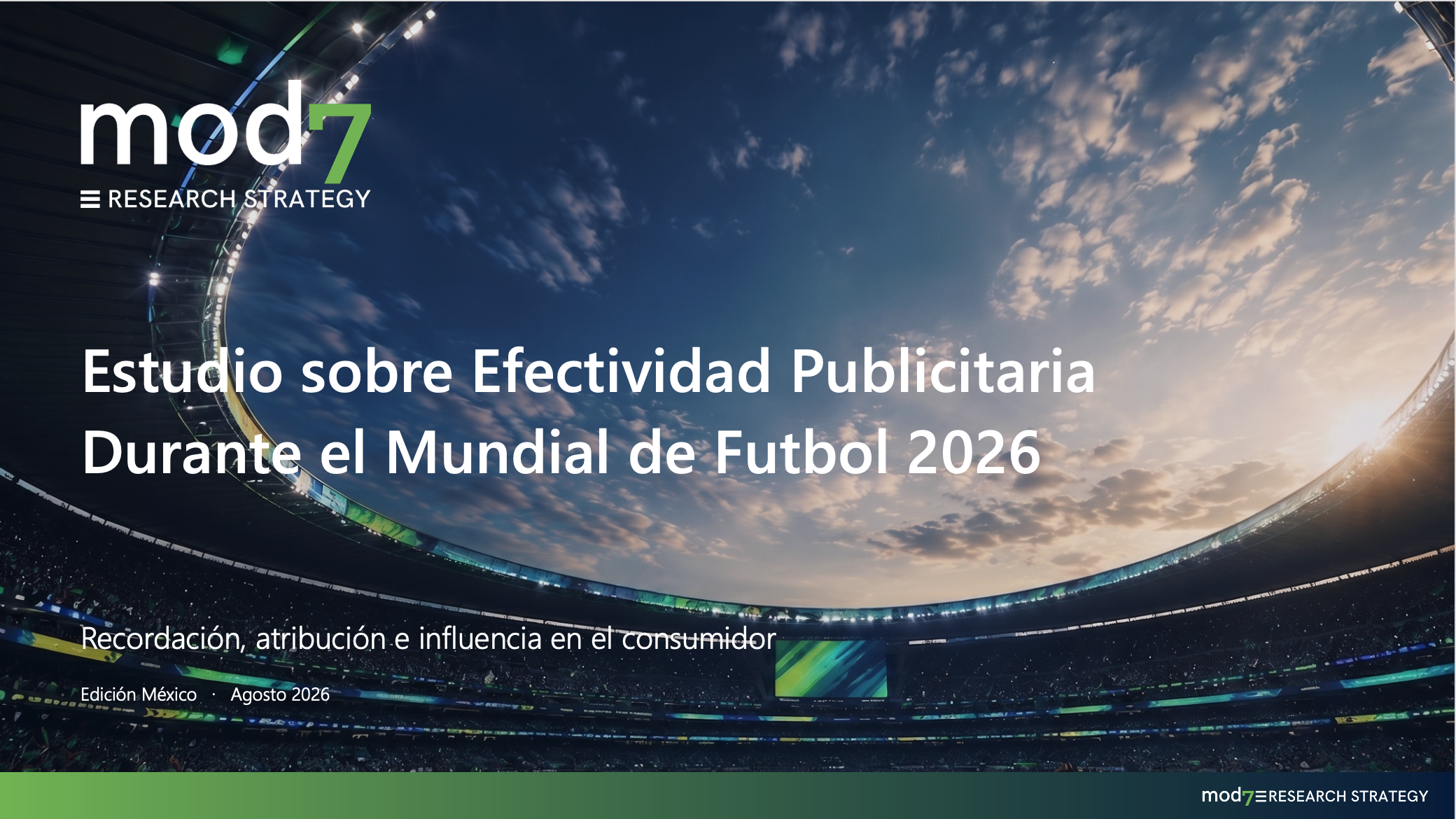
NUEVA YORK, 19 de agosto de 2026 — Exactamente un mes después de que concluyera la Copa Mundial de la FIFA 2026 el 19 de julio, Mod7 Research Strategy publicó hoy el Estudio sobre Efectividad Publicitaria Durante el Mundial de Futbol 2026: Recordación, atribución e influencia en el consumidor (Edición México), un nuevo reporte que ofrece un balance sobre cómo la afición en México siguió el torneo y qué impacto tuvo la publicidad que lo rodeó.
El reporte destaca que el Mundial alcanzó una penetración prácticamente universal entre los adultos encuestados en México: 98% siguió el torneo viendo partidos, noticias u otro contenido relacionado. La exposición comercial fue casi igual de amplia: 94% recuerda haber visto algún tipo de publicidad alrededor del Mundial.
La atención también se trasladó a acciones de consumo. 65% de los participantes dijo haber completado al menos una compra influenciada por publicidad de una marca durante el torneo, aunque el impacto se concentró principalmente en categorías de consumo inmediato y menor costo.
“Un mes después de la final, la atención ya no es la pregunta: prácticamente todo México siguió el Mundial y casi todas estas personas estuvieron expuestas a las marcas que lo rodearon,” dijo Osbaldo Franco, fundador de Mod7 Research Strategy. “La diferencia aparece después, cuando medimos qué marcas afianzaron la recordación, atribución y acción. El Mundial generó una oportunidad publicitaria extraordinaria, pero estar presente no garantizó que una marca dejara huella.”
Otros hallazgos clave:
La televisión conectada (CTV) dominó el contenido en vivo y el smartphone el pregrabado: La CTV fue utilizada por 77% para seguir partidos en vivo, mientras que el móvil fue el preferido para contenido pregrabado con 59%, siendo la única pantalla con mayor uso para ese tipo de contenido que para transmisiones en vivo.
La multipantalla amplificó la oportunidad comercial: Las personas que utilizaron cuatro o más pantallas recordaron 9.4 marcas en promedio y 85% reportó haber comprado.
Las marcas locales mostraron su poder: Sabritas alcanzó 42% de recordación asistida en México, superando a su gemela Lay’s que obtuvo 12%, ambas marcas de PepsiCo. El nombre local obtuvo 3.6 veces la recordación de la marca global.
La fragilidad de la recordación espontánea: Coca-Cola fue la única marca que más de la mitad de la audiencia (52%) mencionó por su cuenta, mientras que otras marcas con alta recordación asistida registraron menciones espontáneas mínimas.
El Estudio sobre Efectividad Publicitaria Durante el Mundial de Futbol 2026: Recordación, atribución e influencia en el consumidor está disponible a partir de hoy en Mod7 Research Strategy con esta liga.
Acerca del Estudio
El análisis se basa en una encuesta online estructurada en español realizada por Mod7 en agosto de 2026 entre 564 adultos residentes en México. El estudio examinó cómo los participantes siguieron la Copa Mundial de la FIFA 2026, los dispositivos y fuentes de información que utilizaron, su recordación espontánea y asistida de marcas, así como sus acciones y consideración de compra reportadas después de estar expuestos a publicidad alrededor del torneo.
Las compras reportadas reflejan influencia publicitaria declarada por los participantes y no deben interpretarse como conversiones verificadas. Asimismo, las relaciones observadas entre uso de múltiples pantallas, recordación y compra representan asociaciones y no establecen causalidad.
Acerca de Mod7 Research Strategy
Mod7 Research Strategy ayuda a las organizaciones a operar con base en evidencia. Diseñamos sistemas modulares y escalables que conectan investigación primaria, insights de experiencia del cliente y marcos de medición en una sola base auditable. Nuestro trabajo genera insights listos para la toma de decisiones que permiten a los equipos actuar con confianza y dar seguimiento a sus resultados de negocios. Más información en mod7research.com.
Contacto de prensa
It All Begins Here
Mod7 Study Finds GenAI Has Reached Majority Adoption in the U.S., but Trust and Monetization Are Growing Constraints
New proprietary research finds 61% of U.S. adults have used generative AI assistants, while non-users remain aware but unconvinced and current users show strong resistance to advertising in AI assistants.
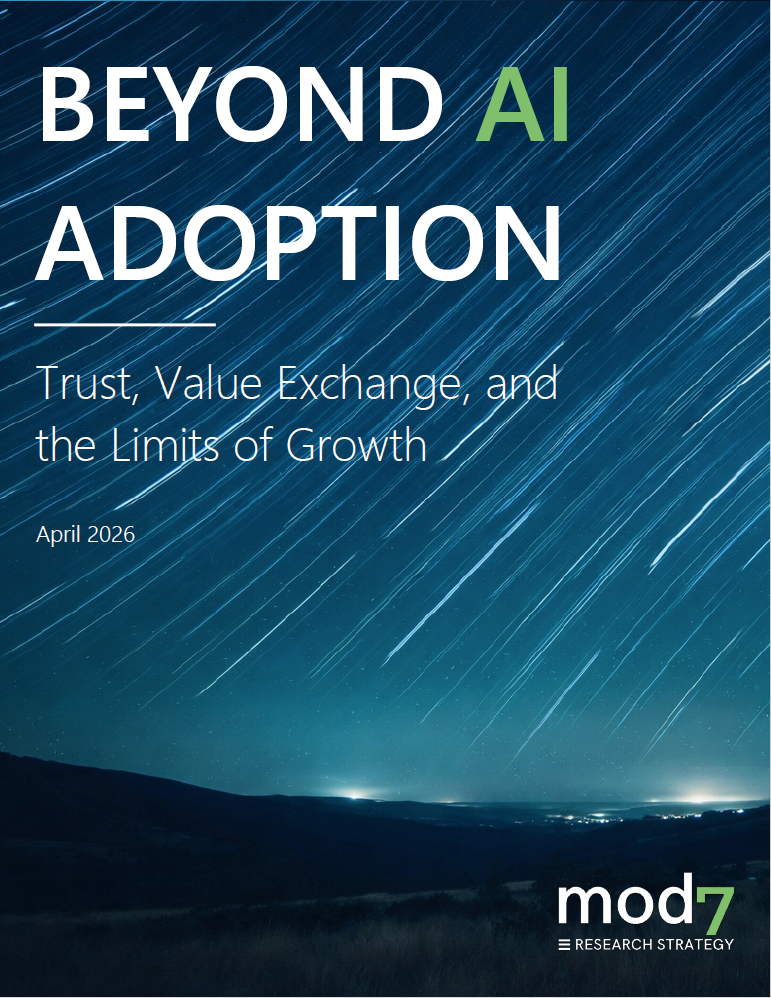
NEW YORK, April 22, 2026 — Mod7 Research Strategy today released Beyond AI Adoption: Trust, Value Exchange, and the Limits of Growth, a new proprietary report examining how U.S. consumers are using generative AI assistants, what is limiting further adoption, and where the next phase of growth is most likely to come from.
Based on a January 2026 survey of 1,068 U.S. adults, with a final effective sample of 881, the research finds that generative AI has moved into the mainstream, but the market is entering a more complex growth phase. Sixty-one percent of U.S. adults have now used generative AI assistants at least once. Further consumer expansion is likely to be constrained by trust, rather than awareness.
Among the 39% of U.S. adults who have not yet used generative AI assistants, ChatGPT is recognized by 77%, Gemini by 57%, and Meta AI by 51%. Only 12% of non-users fail to recognize any major generative AI brand. Privacy, data use, and security concerns top the list of adoption barriers at 34%, followed by ethical anxieties at 30%. More than one-third of never-users say nothing would motivate them to try the technology in the next six months, signaling a principled form of resistance that awareness campaigns and feature improvements are unlikely to solve.
Those same trust dynamics are also shaping monetization prospects inside the active user base.
Key findings include:
46% of current generative AI assistant users resist both advertising and agentic commerce, the two main monetization models taking shape in the category.
67% of daily users say ads inside AI assistants would be intrusive or unacceptable, making the most engaged users the least receptive to traditional ad models.
Daily users engage in an average of 15.4 AI activities, versus 5.5 among monthly users, underscoring how AI use broadens once it becomes habitual.
74% of Millennials ages 30 to 44 use generative AI assistants, making them the most strategically important cohort for the category’s next phase.
The findings point to an alternative commercial path to advertising. Among users who have engaged AI for health, wellness, or emotional support, 54% are open to AI-managed transactions, compared with 19% of non-wellbeing users. This cohort is also more resistant to advertising, suggesting that the most commercially promising users may respond better to utility-driven monetization than attention-based models.
“Our data shows the market has moved beyond the basic adoption question,” said Osbaldo Franco, founder of Mod7 Research Strategy. “The next challenge is earning enough trust to deepen usage while developing commercial models that feel additive, not disruptive, to the experience. That points more clearly toward utility-driven monetization than traditional advertising.”
On the competitive front, ChatGPT remains the market’s primary on-ramp, Gemini the largest challenger at scale, and specialist tools such as Claude and Perplexity continue to gain traction in narrower, higher-value moments.
Beyond AI Adoption: Trust, Value Exchange, and the Limits of Growth is available now from Mod7 Research Strategy here.
About the Study
The analysis is based on a proprietary online survey of 1,068 U.S. adults conducted by Mod7 in January 2026. Following quality assurance protocols, including the removal of speeders, satisficers, and other low-quality signals, the final effective sample was 881. Data was weighted to align with the U.S. adult population across key demographic variables, including age, gender, income, and region.
About Mod7 Research Strategy
Mod7 Research Strategy helps organizations run their business on evidence. We design modular, scalable systems that connect primary research, customer experience insights, and measurement frameworks into a single, auditable foundation. Our work delivers decision-ready insights that enable teams to act with confidence and track business outcomes. Learn more at Mod7Research.com.
Media Contact