
Generative AI Has Reached Most U.S. Adults, Now It Needs to Earn the Other 39%
By Osbaldo Franco, Founder & Principal, Mod7 Research Strategy
April 23, 2026
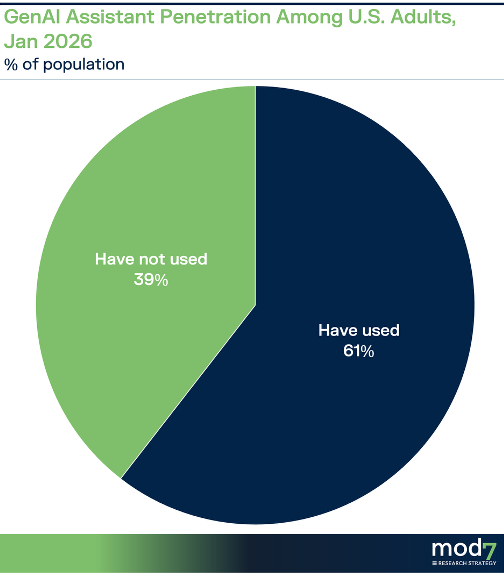
Three years after ChatGPT’s viral arrival, generative AI has crossed an important threshold. According to Mod7’s January 2026 survey of 881 U.S. adults, 61% have used a generative AI assistant at least once. For a category that barely existed in mainstream consumer behavior at the start of 2023, that is a meaningful milestone. But the more revealing figure may be the one on the other side of the chart.
Thirty-nine percent of U.S. adults have not used a generative AI assistant.
That matters because it changes the market story. At this point, generative AI is no longer a pure awareness play. It has reached majority penetration. The next growth challenge is more complex than simply getting more people to notice the category. AI platforms must convince a large segment that these tools are worth trying, trusting, and integrating into daily life.
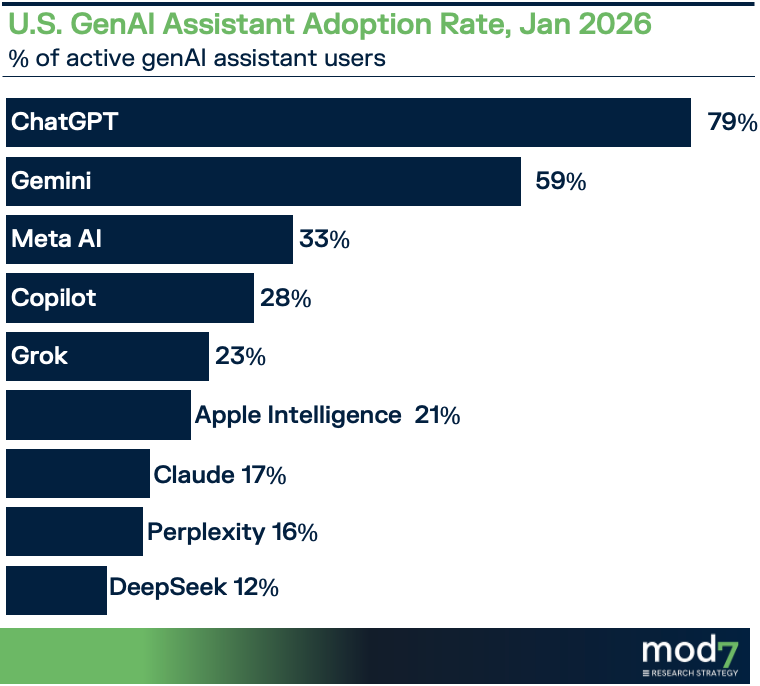
Among active users, ChatGPT holds a commanding 79% adoption rate, well ahead of Gemini at 59%. After that, the market fragments quickly: Meta AI reaches 33%, Copilot 28%, and Grok 23%. Apple Intelligence, Claude, Perplexity, and DeepSeek all have smaller user bases, but they still command meaningful engagement as the AI market becomes more specialized.
This is not the shape of a winner-take-all market. It looks more like a layered one.
At the top are the general-purpose platforms that have become default entry points. Beneath them is a second tier of tools benefiting from distribution advantages tied to larger ecosystems, operating systems, and existing consumer habits. Below that is a specialist layer that is smaller in scale but increasingly relevant as users become more intentional about matching tools to specific tasks.
That structure has direct implications for strategy. For the leading platforms, scale alone is no longer enough. The harder task is to turn trial into habit and habit into trust. For the challengers, the opportunity may be less about displacing the category leader outright and more about winning high-intent moments where users care more about fit than familiarity.
The 39% of adults who remain on the sidelines make this strategic challenge more important. In Mod7’s broader research, non-users do not look like a market that simply has not heard the message yet. They are familiar with the category but have real reservations. Privacy, ethics, and data use concerns dominate their stated reasons for staying out, all barriers that awareness campaigns and product improvements are unlikely to resolve on their own. This suggests the next phase of growth will depend less on top-of-funnel discovery and more on whether AI companies can reduce perceived risk, clarify value, and prove they deserve a larger role in people’s lives.
Generative AI has already won attention. It has not fully won consumer confidence.
That distinction is likely to define the next chapter of the market. The platforms that grow from here may not be the ones that merely add users fastest. Those that do the best job deepening usage among current users while steadily earning credibility with the people still standing outside are the ones most likely to pull ahead from this point forward.
That broader story is at the center of Mod7’s inaugural report, Beyond AI Adoption: Trust, Value Exchange, and the Limits of Growth. The topline adoption figures are important, but the more consequential questions now concern what users are doing once they are in, what holds non-users back, and how much room remains for the category to grow on trust alone.