

Soccer is the only broad sport in the U.S. with a third or more followers who also play
By Osbaldo Franco, Founder & Principal, Mod7 Research Strategy
Sports are often ranked by the size of their audience. Our latest research adds another dimension: the followers of a sport who also take part in it.
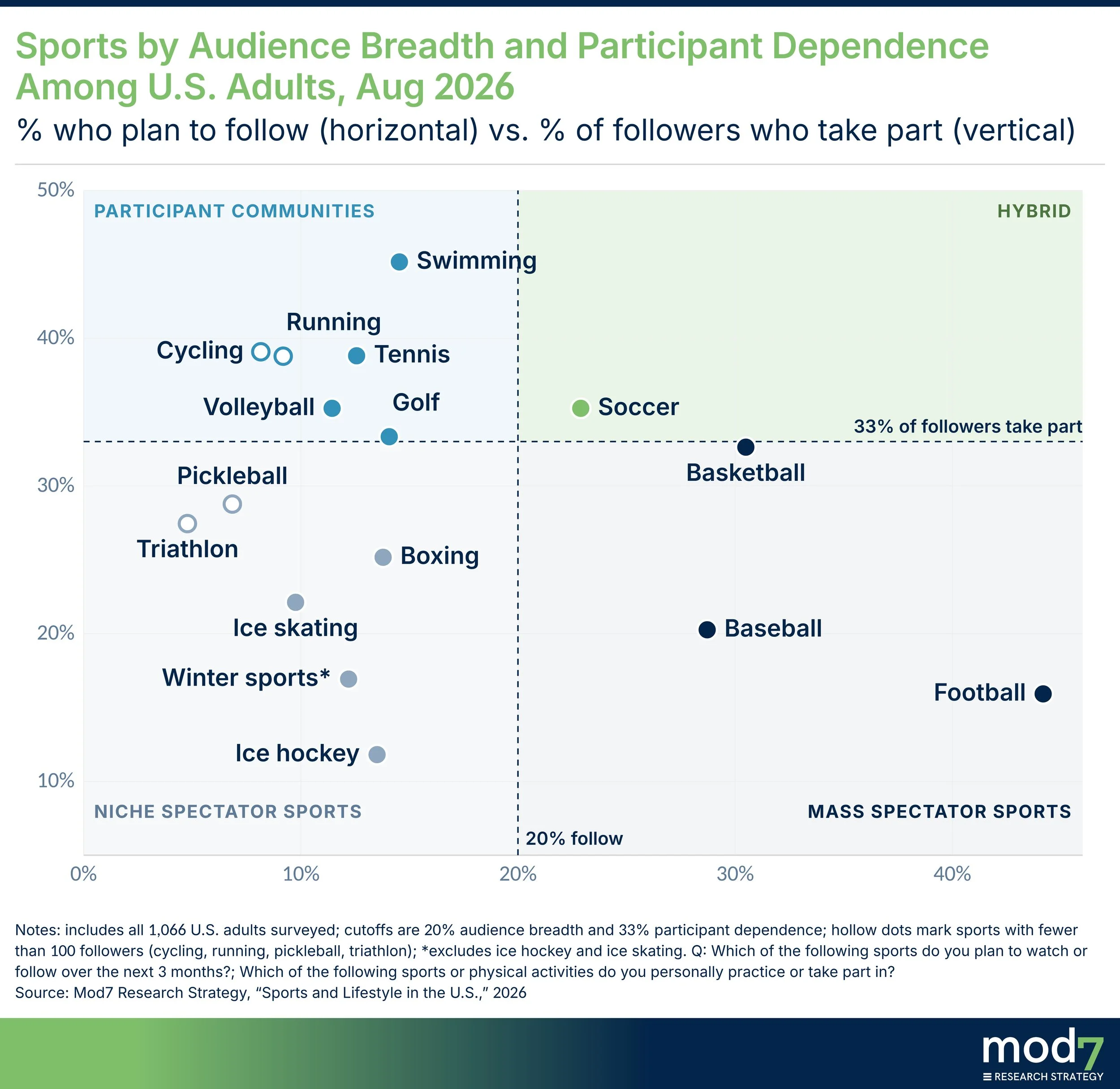
Audience breadth is the share of respondents who plan to follow a sport in the next three months. Participant dependence in the share of those followers who also take part in it, however often.
A sport counts as broad when at least one in five respondents follow it, and as participant-anchored when at least one in three of its followers take part. Combining the two measures, the 16 sports in the survey fall into four groups:
Mass spectator sports: broad audiences in which fewer than a third play. Football, basketball and baseball dominate this group.
Participant communities: smaller audiences in which at least one-third play. Includes swimming, tennis, running, cycling, volleyball and golf.
Niche spectator sports: smaller audiences with fewer than a third who play, such as boxing, winter sports and triathlon.
Hybrid: a broad audience in which at least a third play. Soccer is the only sport in this category.
Spectator sports, big and small, are built for media reach
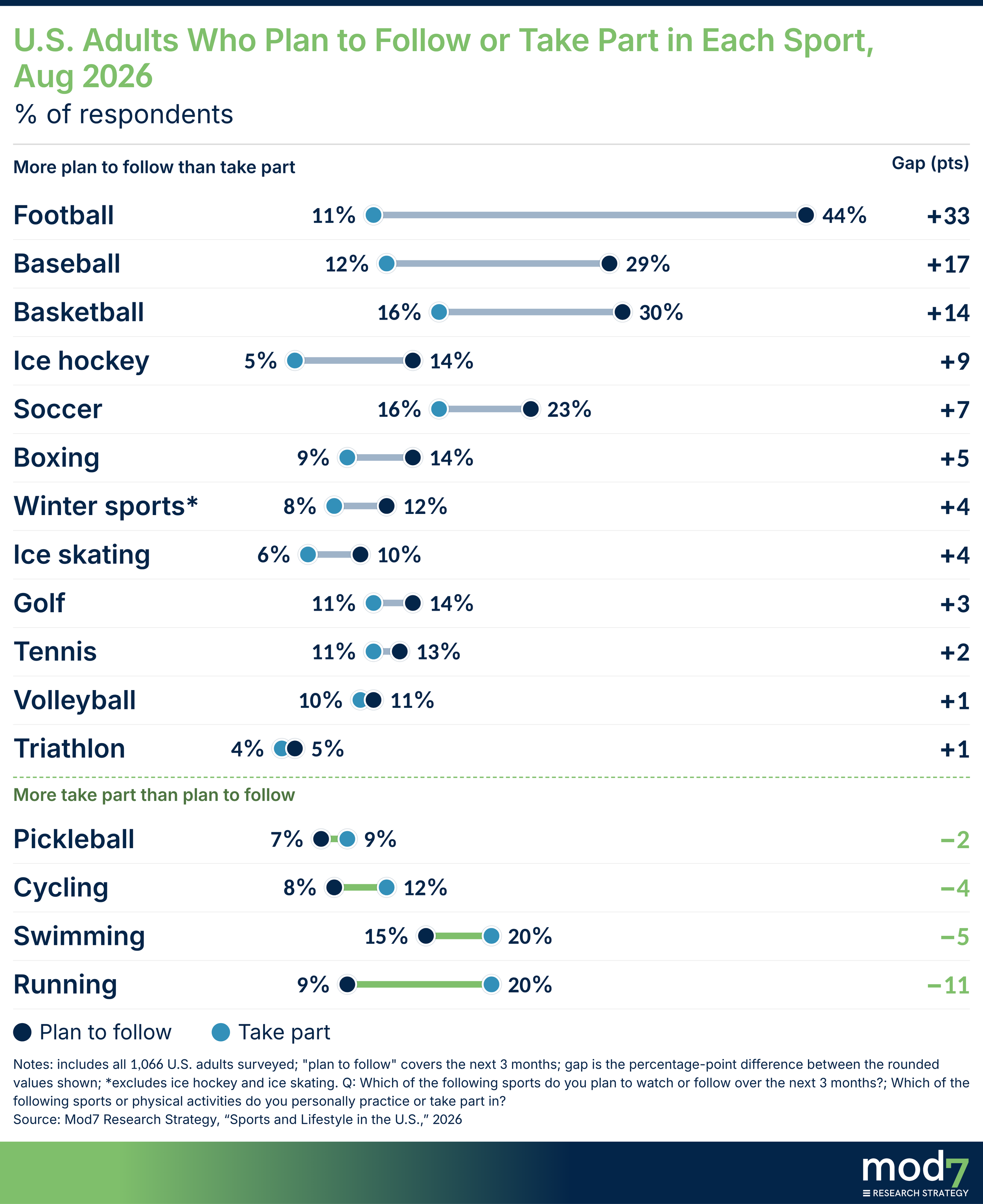
Football has by far the broadest audience (44%), and as our previous article in this series showed, only about one in six of its followers play it (16%). Basketball (30%) and baseball (29%) also clear the breadth bar. Most of their followers don’t play either, although basketball comes closest to meeting the hybrid sport criteria, with just under a third of its followers playing (32.6%).
Football’s audience is massive, and broadcast is built to reach it at scale. Regular season football games averaged 18.7 million viewers in 2025.[1] With so few of its followers playing, a sponsorship aimed at players could reach only a small part of that audience, leaving broad media to do the heavy lifting.
Boxing, winter sports and triathlon follow the same pattern on a smaller scale, with narrower audiences in which fewer than a third of followers play.
The gap between how many adults follow a sport and how many take part in it points to a market audience rankings alone can miss. Sports like running, swimming and cycling have more adults taking part than planning to follow the coverage, with more than twice as many in running (20% vs. 9%). Reaching the people who play without following may take sponsorships and activations beyond the sport’s media coverage, as well as a different set of success metrics.
In participant communities, much of the audience also plays
Swimming, tennis, running, cycling, volleyball and golf have the opposite profile of the spectator sports, with smaller audiences but far more followers who also play their respective sport. None of the six is followed by one in five respondents, yet at least a third of each sport’s followers take part themselves. Swimming, for example, is an activity nearly half of its followers also practice (45%), the highest share of any sport measured.
Our survey shows how much players and followers overlap in these sports. Respondents who play tennis planned to follow it at almost five times the rate of those who don’t (43% vs 9%), and golfers were about four times as likely as non-golfers to follow the sport (43% vs. 11%). Separate research, on fans rather than followers, finds that when a sponsorship gets noticed, its positive effect on brand perception is significantly stronger among fans than among non-fans.[2] Together, they suggest players in these sports could be a receptive audience for sponsors.
The other ingredient is brand fit. Research examining a brand’s sponsorship of a major league club found that fans plus a natural brand fit worked best, and that without either, awareness stayed flat regardless of spend.[2] For brands that sell gear, apparel, nutrition or technology people use when they play, participation sports could offer a natural route to that fit. Our survey can’t say how many players a club, group ride or race actually reaches. But in sports where roughly four in ten followers or more play, like swimming and tennis, a sponsorship aimed at players is also aimed at a sizable part of the audience.
Soccer is the only sport that offers both
Soccer’s audience is both broad and participant-anchored. Nearly one in four respondents planned to follow the sport (23%), and more than a third of those followers also play (35%). The beautiful game gives sponsors reach and a playing community in a single property. Estimates put U.S. soccer fans at 75.2 million as of July 2026,[3] and globally, 67% of soccer fans say sponsoring brands are more appealing to them, compared to 54% of the general population.[4]
Soccer is the only sport that offers both
Success looks different in each sports group. In mass spectator sports, reach and frequency carry the weight. In participant communities, the better test is whether a brand moves consideration among the people who play. In both cases, sponsorship continuity counts.[2]
These groups speak to what a sponsorship actually buys in each sport. Mass spectator sports offer reach. Participant communities offer smaller but engaged audiences that play the sport they follow. Soccer, unusually, offers some of both benefits.
———————————————————————
———————————————————————
Notes
[1] Nielsen as cited by Sports Media Watch, “NFL records its highest regular season average since 1989,” Jan 2026.
[2] Ipsos, “The Long and Short of Sports Sponsorship,” May 2026.
[3] Nielsen as cited by Front Office Sports, “Nielsen: Post-World Cup Soccer Audiences Surge Among Young Viewers,” Oct 2026
[4] Nielsen, “2025 Global Sports Report,” June 2025.