
The AI Advertising Paradox
Is the ad industry solving for the wrong problem?
By Osbaldo Franco, Founder & Principal, Mod7 Research Strategy
May 14, 2026
The advertising industry is rushing to buy space inside AI assistants. The more important question is whether investment in that space is the right move right now.
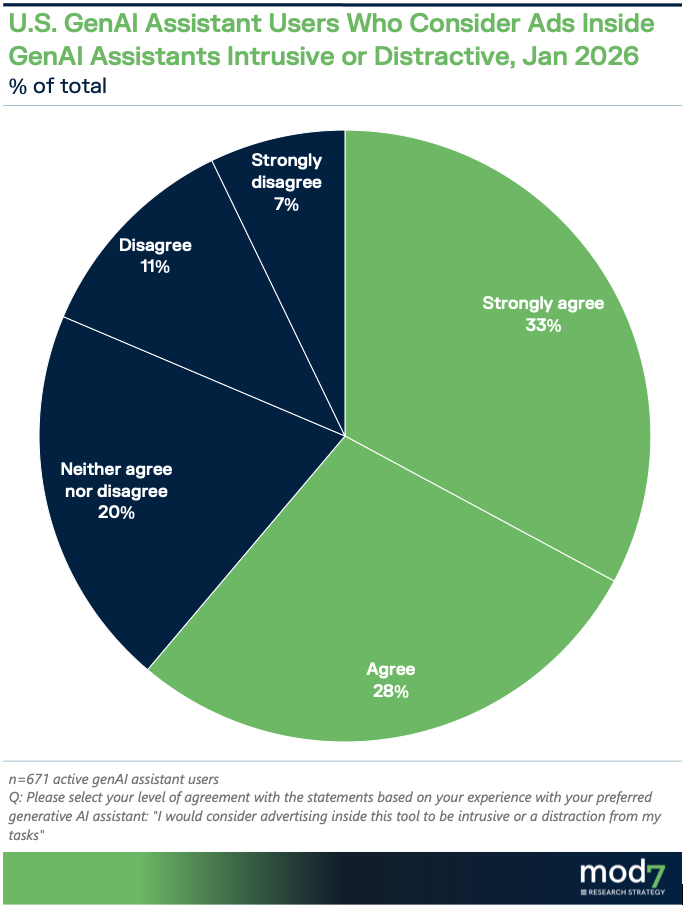
Our Beyond AI Adoption study found that 61% of current genAI assistant users consider advertising intrusive or unacceptable in these environments. That figure reaches 67% among daily users, who are also among the most commercially ready AI users. The instinct in the industry has been to treat this as a negotiation: test formats, adjust placement, soften the experience until the numbers improve. OpenAI's ChatGPT ad pilot, which topped $100 million in annualized revenue within six weeks of launching in early 2026,[1] is being read as evidence that the negotiation is going well.
But there is a second signal in the data that the industry is underweighting, and it points in a different direction entirely.
A Recommendation Gap
The same users who reject ads are highly responsive to AI-driven recommendations. Nearly half of active AI users in the U.S. say they are likely or very likely to try a different brand than usual based on AI assistant suggestions.[2] Shopping-related AI use grew 35% in just nine months through late 2025, with more than 60% of consumers expressing high trust in GenAI results across the purchase journey.[3] Crucially online visitors arriving from AI platforms, while small in numbers still, appear to convert at rates nearly nine times higher than the organic search baseline.[4]
The evidence implies that the value for brands in AI environments lives within the response to a query, not in the placement of a creative next to it. This distinction is key as it shows that users are not rejecting AI's commercial influence, just the form it takes when it looks like an ad.
The SEO Parallel
The obvious comparison is the modern search economy. Google did not become a nearly $5 trillion company primarily by selling banner ads alongside search results. It monetized commercial intent at the precise moment a user signals what they are looking for, putting the most relevant results, organic and paid, directly in the path of that intent.
AI assistants are now a discovery surface of comparable power, leading to projections that traditional search volume will decline 25% by 2026 and 50% or more by 2028, as users migrate toward AI-driven answers.[5] The IAB called this a "wake-up call" at its 2026 Annual Leadership Meeting, adding that “discovery is shifting from links to conversations, mediated by agents and LLMs,” and the entities that decide what gets recommended have changed.[6]
The mounting evidence suggests the question brands should be asking is not "how do we buy an ad slot?" but "how do we become the answer?"
The answer already exists: Generative Engine Optimization, or GEO, is the emerging discipline of structuring content and authority so that AI systems cite, reference, and recommend your brand when relevant. The practice was formalized in academic research in 2024 and has moved quickly into mainstream marketing, with 73% of marketers already optimizing for AI-generated answers,[7] and GEO now representing the top priority for nearly a third of digital marketing leaders.[8]
The Commercial Opportunity is Real. Picking the Right Format is the Problem.
Mod7’s Beyond AI Adoption report identified the omnivore pattern: a tendency of high-frequency AI users to engage across a wide range of activities including product research, comparison, and purchasing decisions. That breadth signals a commercial opportunity inside AI assistants that is real and large. AI platforms are forecasted to account for $20.57 billion in U.S. retail e-commerce sales in 2026 alone, nearly four times the 2025 figure.[9]
But our data also shows these users are resistant to attention-based monetization precisely because they are the most engaged. The daily users who drive that commerce activity are the same cohort that registers 67% ad resistance. They are not opposed to being influenced by AI, just to being interrupted by it.
The format implications are significant. Early ChatGPT ad units are showing click-through rates of around 0.91%, compared to 6.4% for Google Search, according to advertiser data from the early pilot.[10] That is a 7x gap, not just a tuning problem. It is a signal that conversational environments do not behave like search pages, and the metrics that defined performance in the prior era do not transfer cleanly.
The brands best positioned to win in this environment are not necessarily the ones with the largest display ad budgets. Those that have become authoritative enough through earned media, genuine category credibility, thought leadership, and structured content stand the best chance for AI systems to cite them when users ask the questions that matter. That is a different capability than buying media, and it requires a different investment.
The industry is not wrong to experiment with paid placements in AI. But it would be wrong to stop there.
[1] Reuters, “OpenAI’s US ad pilot exceeds $100 million in annualized revenue in six weeks,” March 2026
[2] EMARKETER and Publicis Commerce, “LLM Usage and Trust in the Shopping Journey,” March 2026
[3] BCG, “Consumers Trust AI to Buy Better. Brands Need to Move Quickly,” December 2025
[4] Seer Interactive, “How Traffic from ChatGPT Converts,” June 2025
[5] Gartner, “Predicts 2024: How GenAI Will Reshape Tech Marketing,” February 2024
[7] IAB, “2026 IAB Outlook Study,” as cited by EMARKETER, January 2026
[8] Martech, “The competition for brand visibility has moved to AI search,” February 2026
[10] AdWeek, “OpenAI is Testing An Ads Manager, As Its New Ads Business Fights Growing Pains,” March 2026