
The Omnivore AI Pattern
Why the killer app strategy might fail
By Osbaldo Franco, Founder & Principal, Mod7 Research Strategy
May 12, 2026
The tech industry is still searching for the killer app for generative AI. Product roadmaps are being built assuming that users want specialized tools to solve a narrow problem, whether writing code, fixing spreadsheets, or summarizing emails. This assumption is likely flawed.
In our latest report, Beyond AI Adoption, we found that the most engaged AI users do not behave like specialists. They are omnivores who use AI to navigate their day, not just to perform a task. As users move from “trying” AI to “living” with it, their usage gets wider, not just more frequent.
The Myth of the Specialized User
On the surface, the utility of AI seems predictable. Among current genAI assistant users, personal usage is dominated by search-adjacent, low-friction tasks:
65% use it to get quick answers to everyday questions
55% use it to learn something new
53% use it to research a product or service they’re planning to buy
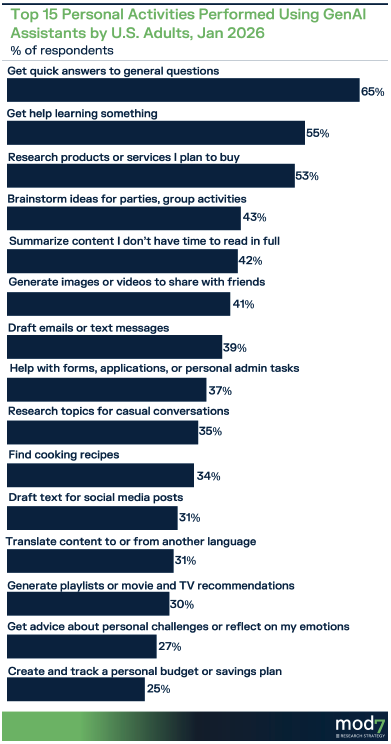
If you stop there, you build a better search engine. The overlap between these tasks tells a more interesting story. Quick answers to everyday questions and learning new topics are tightly linked, with product research often sitting in the same behavioral space. As frequency of use grows, users appear to develop a continuous loop: ask, learn, compare and decide, effectively treating AI assistants as a cognitive system rather than a series of standalone apps.
The Breadth Gap
The key divide in the AI market in 2026 is the breadth gap between the omnivore and casual users.
Frequency of use is one of the clearest markers of how many different ways a person will use AI. The contrast is stark:
Daily users: average 15.4 activities and 3.4 assistants
Monthly users: average 5.5 activities and 1.7 assistants
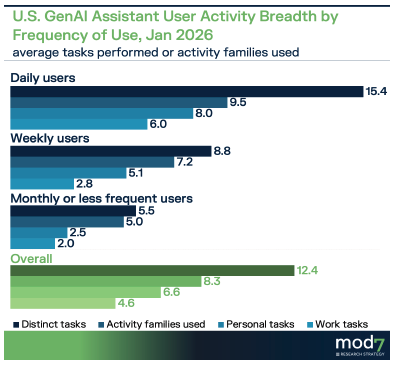
Once AI becomes a daily habit, the user stops seeing it as a “writing tool” or a “research tool.” Across the market, that wider routine already includes lower-frequency but revealing use cases like social media drafts (31%), translations (31%), and tracking personal budgets (25%).
This shift is heavily influenced by age. Gen Z users, ages 18 to 29, are already operating at a breadth of 10.2 activities, despite lower engagement in productivity tasks than millennials, while baby boomers, ages 60 and older, remain more task-focused, averaging 4.1 activities.
What This Means for AI Platforms
The app economy trained users and platforms to operate in terms of specialized utility: one tool, one job. GenAI users are not fragmenting their behavior in the old app-economy way, though. They are expanding their toolkits, adding Claude for high-fidelity work or Meta AI for social environments, but they do not appear to be looking only for niche tools. They seem to be choosing the best do-it-all solution for specific environments and might come to expect their Work AI to be as omnivorous as their Personal AI.
Our data suggests that viable winning strategies for AI labs go beyond simply outperforming the incumbent in one specialized category. Building an environment where an omnivore can move across tasks without friction, while still offering enough depth for the moments that matter most, might prove highly successful.
There is, however, one critical caveat: this environment must also address the AI trust deficit. Our data shows that further AI expansion will be limited unless platforms can resolve deep-seated consumer concerns about privacy, security, and accuracy.
The omnivore pattern is already the norm for the power users who represent the vanguard of the AI market. The rest of the industry just hasn’t caught up yet.