

Generative AI Adoption is Broad, But the User Base Has Layers
By the Mod7 Research Strategy team
5/6/2026
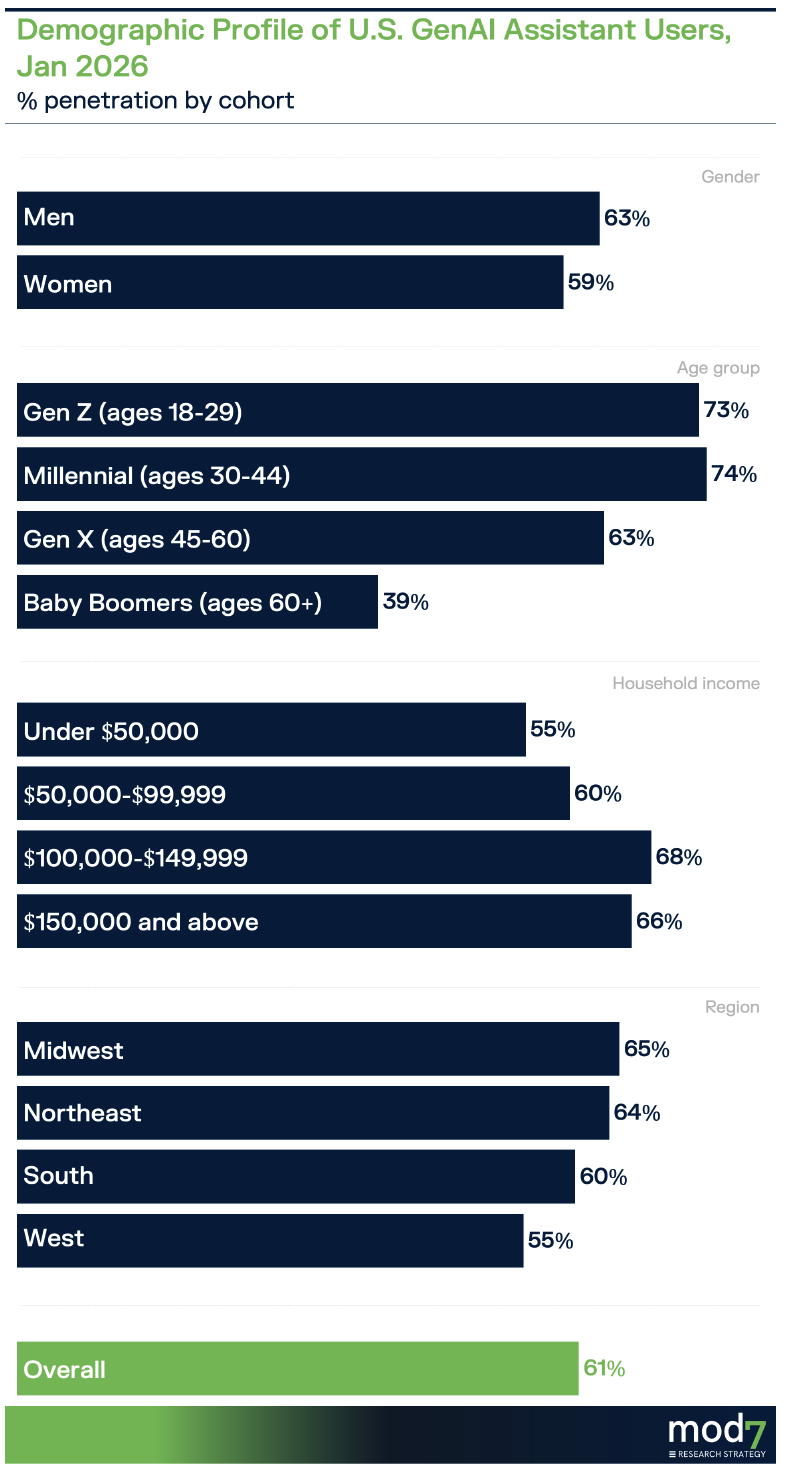
Mod7’s latest research found that 61% of U.S. adults have used generative AI assistants as of January 2026. The topline figure might be eye-catching, but a deeper look at the demographic breakdowns reveals a broad consumer base that is far from uniform.
Adoption among men and women is closely matched, at 63% and 59%, respectively. That sets generative AI assistants apart from prior technology categories that skewed heavily male in their early years. At the tool level, however, gender differences become more legible: men are significantly more likely than women to use Claude, Copilot, Grok, and Perplexity.
The starker divide is age
Adoption is nearly identical among the two youngest generations, standing at 73% among Gen Z and 74% among Millennials, while reaching 63% among Gen X and 39% among Baby Boomers.
Gen Z and Millennial adoption rates might be closely tied, but these cohorts do not represent the same kind of user. The youngest adults help drive volume and familiarity. They are the most likely to use ChatGPT, the tool that functions as the primary on-ramp to the category, at 75% uptake compared to 66% among Millennials and 61% among Gen X.
The youngest cohort uses AI primarily as a general-purpose learning and assistance layer. Millennials, however, are the engine behind broader tool adoption and more varied use cases. They are the most likely to use Copilot (28% uptake), the tool integrated with Microsoft’s productivity suite, and use of genAI assistants for productivity and technical tasks peaks within this cohort. Millennials are also the age group most open to AI managing purchases or transactions on their behalf, a finding with significant commercial implications.
Income adds another layer
Adoption is lowest among adults living in households earning under $50,000 at 55%, rising to peak at 68% among those earning between $100,000 and $149,999, then tapering slightly to reach 66% at the top of the earnings scale.
Regional differences are narrower but still visible. The West stands out with only 55% of adults reporting generative AI assistant use, the lowest of any U.S. region.
Generative AI has moved into the mainstream, but its center of gravity leans younger, higher-income, and more task-oriented.
Download the full report: Beyond AI Adoption: Trust, Value Exchange, and the Limits of Growth
Additional insights: mod7research.com/insights
Visit our website: mod7research.com
Media inquiries: media@mod7research.com